Non-dissipative, spin-polarized edge channels
Topological magnetic insulators* exhibit the
quantum Hall
effect* in zero magnetic field. In these materials, known as
Chern insulators*, a spin-polarized current flows only along the edges of the material, in a given direction set by the magnetization. This topological property leads to the
quantization of the transverse resistance*, which is of interest for quantum metrology. Furthermore,
this
one-dimensional spin transport is ballistic (no dissipation), and the direction of flow (chirality) can be reversed by
switching the material's magnetization
by applying
a
small magnetic field.
Topological Circuits in Quantum Spintronics
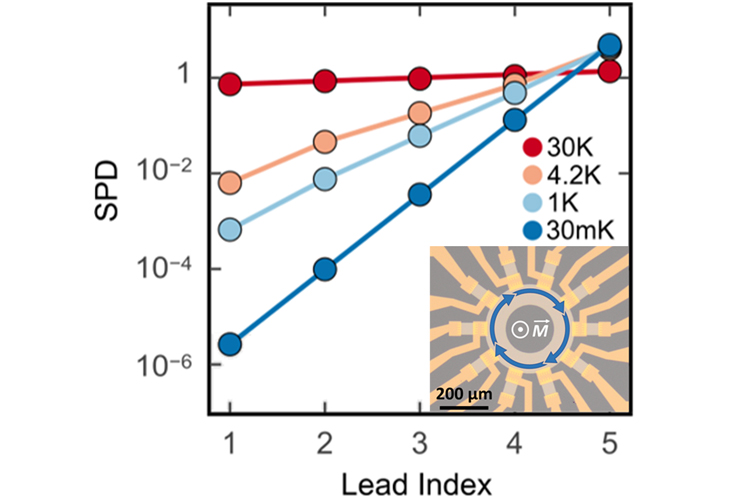
Until now, topological electronics based on the quantum Hall effect relied solely on the topological properties of quantum materials. The researchers have demonstrated a new topological property—known as “non-Hermitian"—specific to a non-reciprocal electronic circuit, in a quantum spintronic device created by connecting chiral edge states in series between dissipative contacts. By considering a multi-connected ring geometry, the topology of the device's
conductance tensor* is equivalent to that of a 1D chiral quantum chain. It exhibits a specific quantum signature corresponding to the exponential localization of states at one end of the device—the non-Hermitian skin effect, a property that does not exist in Hermitian systems. This localization makes the system particularly sensitive to variations in boundary conditions, enabling the development of a new type of ultra-sensitive cryogenic quantum sensors. With a magnetic topological insulator, such as (Cr,Bi,Sb)2Te3 used in this study, non-Hermitian quantum spintronic devices are realized in zero magnetic field, with a record amplitude of the localization in a quantum Hall device (see figure).
© CEA/SPINTEC/R. Giraud
Figure : Exponential localization of quantum states (SPD, “sum of probability densities”) at one edge of the device (contact #5) in an open-chain geometry with five active contacts, measured at different temperatures.
Insert: Ring (light gray) operated in the anomalous quantum Hall effect regime, with ten pairs of ohmic contacts (yellow). The direction of magnetization determines the chirality of the 1D edge states. The choice of active contacts determines the size of the quantum chain.
Applications of Quantum Detection
Obtained without the need of an experimental setup at the metrology grade, this new generation of cryogenic quantum sensors is particularly well-suited for applications in industry, in setups working at 4.2K. Since their exponential response can be tuned by the magnetization, these devices can be operated as magnetic sensors with a very high sensitivity, in the nT range for a 5-site chain. Furthermore, theory predicts that the device performance can improve exponentially by increasing its length, to a level of accuracy comparable to that of magnetic sensors based on other, more complex technologies such as superconductivity, the Hall effect, or classical spintronics. More broadly, this work illustrates the potential of topological magnetic materials for developing new functions in quantum sensing and information processing, based on the non-reciprocity of a quantum circuit in spintronics.
Non-Hermitian topology*: a property associated with the non-reciprocity of a quantum system, leading to the exponential localization of states at one end of the system.
Quantum anomalous Hall regime*: a quantum Hall effect induced by the magnetization, without the need to apply an external magnetic field.
Quantum sensors*: devices that use quantum properties (superposition, entanglement, quantization, interference) to detect and measure physical phenomena with increased sensitivity.
Topological magnetic insulator*: a material combining magnetism and non-trivial topology of the electronic bands; it is an insulator in the bulk but possesses chiral edge states controlled by the magnetic order (Chern insulators, axion insulators) and protected from perturbations by topology.
Quantum Hall effect*: a quantum phenomenon in which, at very low temperatures and under the influence of a strong magnetic field, electric current is carried without dissipation by electronic states along the edges of the material.
Chern insulator*: a magnetic topological insulator exhibiting an anomalous quantum Hall effect induced by magnetization: chiral edge states appear in the absence of an external magnetic field. Spins can thus circulate in a single direction—a direction that can be controlled by the material's magnetization—and transport is ballistic.
Quantization of transverse resistance*: resistance measured perpendicular to the current, whose exact value depends only on fundamental constants (electron charge, Planck's constant); it serves as the resistance standard in quantum metrology and is used in the International System of Units since 2019.
Conductance tensor*: a matrix describing all conduction paths in a multi-terminal device. Its eigenvectors determine the potential distribution across the circuit's active contacts, from which the localization of quantum states (SPD, “sum of probability densities") is calculated.
UMR : SPINTEC (CEA, CNRS, UGA, Grenoble-INP UGA)
Fundings : H2020 FET Proactive project TOCHA (No. 824140); CNRS IRP CITRON.
Collaborations : RIKEN-CEMS, IFW Dresden.