With more than 7,000 diseases identified to date, affecting a total of 3 million people in France, the diagnosis of rare diseases is a major public health challenge. Rendu-Osler disease is a rare genetic disorder whose symptoms worsen with age. Patients suffer in particular from frequent and profuse nosebleeds, which can sometimes require blood transfusions. The disease can also cause malformations between veins and arteries in vital organs (such as the liver, lungs, and brain), which can rupture and cause hemorrhages. Not all of the genetic mutations responsible for the disease have yet been properly identified, delaying diagnosis—and, consequently, patient care—by several months. The goal of our study is to help doctors and hospital laboratories make a diagnosis more quickly.
Researchers at
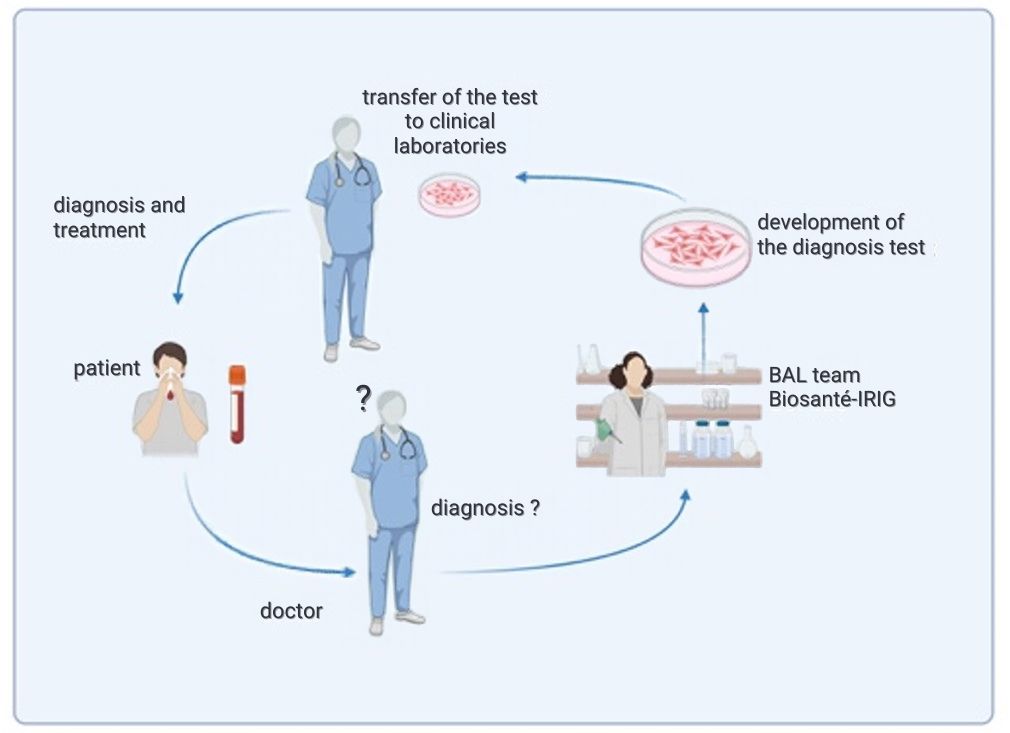
CEA-Irig/Biosanté work closely with the Hospices Civils de Lyon, the national reference center for Rendu-Osler disease. Using blood samples from patients with an uncertain diagnosis, mutations in a gene (GDF2) were detected, although their link to the disease had not been clearly established. In the laboratory, we reproduced these mutations and developed an in vitro cellular assay in which we tested the biological activity of the proteins carrying these mutations. If the activity is normal, the mutation is considered benign. However, if the activity is reduced, this means that the mutation prevents the protein from functioning normally. The mutation is then considered pathological and contributes to the development of the disease.
© Image generated by BioRender
Figure : A patient carries a mutation in a gene whose link to Rendu-Osler disease is uncertain. In the laboratory, a test is developed to analyze this mutation. The result enables the doctor to make a diagnosis and establish a follow-up plan for the patient.
This test has been made available to clinical laboratories, which can now determine whether a mutation is benign or, if it does not explain the disease, whether they should look for other mutations (in other genes) that may not yet have been identified.
Functional tests previously developed by the team and transfered to the clinical laboratories:
Despas L, Vialet L, Tusseau M, Azemard V, Beurier-Soulat L, Al Tabosh T, Auboiroux C, Parrot A, Blivet S, Le Guillou Horn XM, Lesca G, Dufernez F, Coulet F, Richardot C, Macias M, Giraud S, Guilhem A, Dupuis-Girod S, Bailly S, Desroches-Castan A. Development of a functional assay for the characterisation of SMAD4 variants from the French haemorrhagic hereditary telangiectasia cohort. J Med Genet. 2025 Nov 21;62(12):741-749. doi: 10.1136/jmg-2025-110797. PMID: 40835297; PMCID: PMC12703305.
Mallet C, Lamribet K, Giraud S, Dupuis-Girod S, Feige JJ, Bailly S, Tillet E. Functional analysis of endoglin mutations from hereditary hemorrhagic telangiectasia type 1 patients reveals different mechanisms for endoglin loss of function. Hum Mol Genet. 2015 Feb 15;24(4):1142-54. doi: 10.1093/hmg/ddu531. Epub 2014 Oct 13. PMID: 25312062.
Ricard N, Bidart M, Mallet C, Lesca G, Giraud S, Prudent R, Feige JJ, Bailly S. Functional analysis of the BMP9 response of ALK1 mutants from HHT2 patients: a diagnostic tool for novel ACVRL1 mutations. Blood. 2010 Sep 2;116(9):1604-12. doi: 10.1182/blood-2010-03-276881. Epub 2010 May 25. PMID: 20501893. |
UMR : Biosanté (CEA-INSERM-UGA).
Fundings : This work was funded by the National Institute for Health and Medical Research (INSERM), the University of Grenoble-Alpes, the CEA (Commissariat à l'énergie atomique et aux énergies alternatives DRF/IRIG/DS), the Fondation pour la Recherche Médicale (EQU202003010188), ANR-21-PMRB-00075 (PAMPERO), and by the national rare disease plan from the French Health Ministry (DGOS) via FAVAMulti (BRAVO).
Collaborations : Hospices Civils de Lyon; . Sorbonne Université, AP-HP Pitié-Salpêtrière; Université Paris Cité, CNRS, Inserm; CHU Lille; CHU Clermont-Ferrand, Hôpital Bicêtre ; Université Paris-Saclay, Hôpital Marie Lannelongue Hospital, Le Plessis-Robin.
|