 «
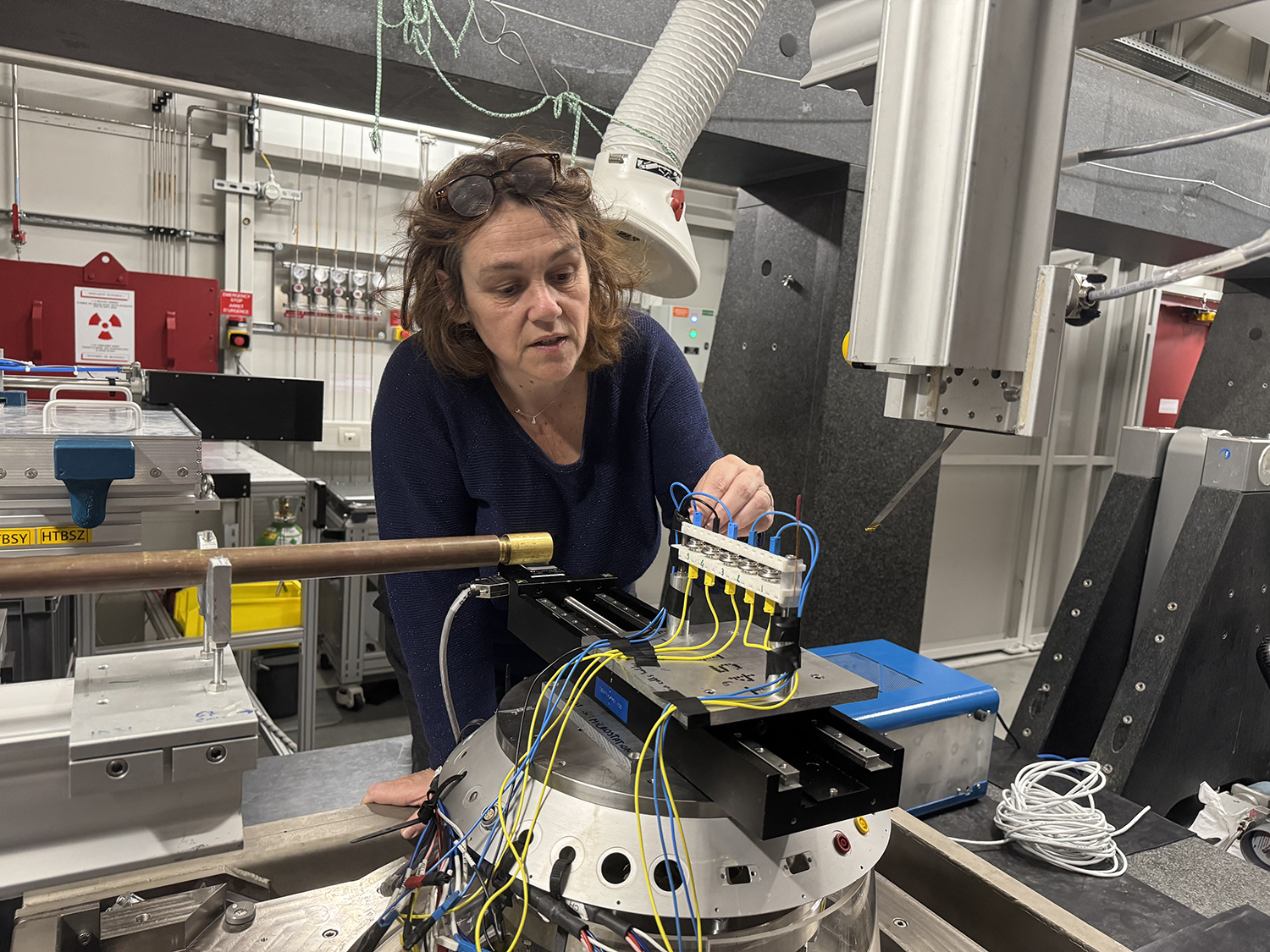
X-rays and neutrons allow us to see what is happening inside a battery whilst it is operating, with an exceptional spatiotemporal resolution. My work involves developing a portfolio of operando techniques at Large Scale facilities (ESRF,
ILL) and combine them. We make our multimodal approach more standardized and accessible, particularly to meet the needs of industry in this sector. Our goal is to better understand what governs battery function and performance, to help developing and optimizing batteries that are more environmentally friendly, more durable and safer. »
Sandrine Lyonnard, a research director at
CEA-Irig/SyMMES, is an engineer and physicist. She obtained her PhD from the University of Orsay in 1997 and joined CEA Saclay in 2000. In 2002, she moved to Grenoble to study the properties of materials for energy applications. She spent 15 years working in hydrogen fuel cell research before shifting more recently to batteries. She is currently guest professor at Uppsala University.
Specialist in neutron and X-ray scattering techniques applied to complex materials, she coordinates two European infrastructures for battery characterization at Large Scale Facilities (synchrotron and neutron hubs). Her group is developing advanced analysis methods and workflows to study reaction mechanisms and degradation processes in operando mode, from the particle scale to the complete electrochemical system. This integrated experimental approach is crucial to reveal the origins of structural and chemomechanical heterogeneities both in laboratory cells and industrial elements.